To start the project I went browsing in my local Bric-a-brac store, they have a lot of old books. I found a copy of The Sleeping Beauty which was illustrated with paper cuttings/silhouette, this offered lots of interesting possibilities to me.
I wanted to alter the book and give it a new life. I looked and I read, and eventually I started cutting into the book in a way the characters began to jump out of the pages whilst still leaving the book intact. I found it really absorbing after the first hesitant cuts.
I made a small hanging to complement the book where I incorporated some roses cut from the book, which also depicted the main characters in the story.
The project was fun, absorbing and satisfying. It came to a natural conclusion, and at this point I am not sure what next. What I did learn was that I enjoy working with books and would like to explore it further.
Merete
1 November 2012
21 September 2011
New challenge - using a book
Not sure whether to call this altered book or not.
Anyway. for those following (and gave up on us) we got caught up in the exhibition Whatever Floats Your Boat by Thames Valley Contemporary Quilt at the Slough Museum. So, we didn't spend much time together talking about anything else!
but now we are hoping to do something for us again, and we are looking at the idea of using a book in some way.
So, this week I have been investigating Book Sculptures. I frequently follow links admiring this sort of work. So I googled the phrase "how to make book sculptures." through that got an idea of what I might like to attempt. You should try it, very interesting things going on out there.
Then I had a look at the rescued books I have picked up here and there.
I have used a bit of this book about writing letters before. So, I decided to combine that with something else I am interested in...Letters from Illuminated Manuscripts or at least from books from the Middle Ages.
At this point I am thinking of using these letters with the writing letters book. They seem to want to go together. I am going to combine some letters to create the ones needed to complete the modern alphabet.
I am not sure if we are meant to use stitch, too. But once I get going, I can work that in.
PS I saved the pages about how to address letters to Royalty! I might need it. HA! well, they might want to be in their own piece.
Anyway. for those following (and gave up on us) we got caught up in the exhibition Whatever Floats Your Boat by Thames Valley Contemporary Quilt at the Slough Museum. So, we didn't spend much time together talking about anything else!
but now we are hoping to do something for us again, and we are looking at the idea of using a book in some way.
So, this week I have been investigating Book Sculptures. I frequently follow links admiring this sort of work. So I googled the phrase "how to make book sculptures." through that got an idea of what I might like to attempt. You should try it, very interesting things going on out there.
Then I had a look at the rescued books I have picked up here and there.
I have used a bit of this book about writing letters before. So, I decided to combine that with something else I am interested in...Letters from Illuminated Manuscripts or at least from books from the Middle Ages.
At this point I am thinking of using these letters with the writing letters book. They seem to want to go together. I am going to combine some letters to create the ones needed to complete the modern alphabet.
I am not sure if we are meant to use stitch, too. But once I get going, I can work that in.
PS I saved the pages about how to address letters to Royalty! I might need it. HA! well, they might want to be in their own piece.
11 November 2010
Working in 3-D
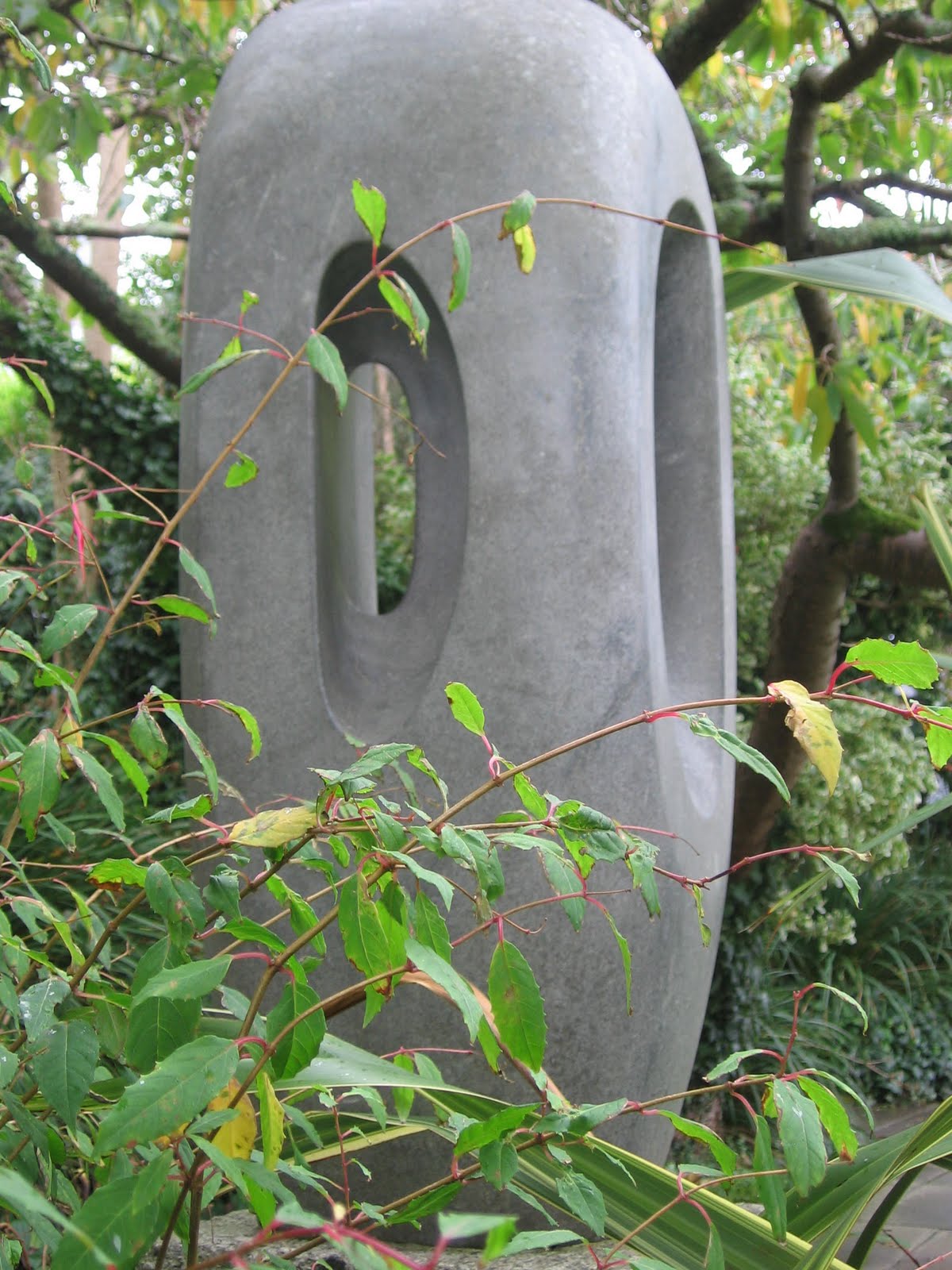
We have been experimenting with 3-D, I certainly found it a struggle. I tend to think about 3-D as something which can be viewed from several different angles. So far so good! I recently visited St Ives in Cornwall and I saw the Barbara Hepworth Museum. In the garden which is on a steep slope is a collection of her wonderful sculptures. As you walk around you keep getting very different views, but what really struck me was a sense that she could feel a sculpture in all its dimensions, from inside out, from top to bottom, turning and rotating it on an axis and at different angles. I'm not sure my brain has the capacity to that, I have problems with garments turned inside out!
Merete
16 October 2010
Triangle experiments - finished!
My "suspension bridge" (although I am not calling it that.) I think I will call it 'Points on a Journey', as it is about the journey and meeting places and stops along the way.
The cord wasn't quite behaving as I would like. Too stiff to drape and yet not stiff enough to be straight. So, I put some dangley bits between, which adds a bit more interest and actually helps keeps the triangles upright. The small end ones kept being pulled over though, so they get their own dangles on the front to weight them properly.
Merete's box in the background.
The cord wasn't quite behaving as I would like. Too stiff to drape and yet not stiff enough to be straight. So, I put some dangley bits between, which adds a bit more interest and actually helps keeps the triangles upright. The small end ones kept being pulled over though, so they get their own dangles on the front to weight them properly.
24 September 2010
Triangle experiments - 3
The 3D triangle experiment came to a bit of a halt while I worked out how to keep the triangles upright. I had the bright idea of using springs - in sort of a mini toast rack effect - to work as "feet". However, I needed time to go find out where I could get any. After a bit of a search I remembered the ironmongers in Great Hollands that has everything...including a few bags of random springs. A rummage produced these which work nicely.
These are just stuck in, but they do what I want them to do. I will make sure they are evenly spaced and stitch them on.
Now that I know they will stand up, I can go ahead and do the suspension bridge cords to join them. I can also go ahead and do some embellishment...although I am growing fond of them just as they are.
I will probably be a bit more restrained than usual...if you can believe that.
As Merete commented earlier,
I had thought to use triangles as feet, but the engineering and product testing time is a bit hard to come by at present. This was simple and effective and won't distract from the triangles themselves.
These are just stuck in, but they do what I want them to do. I will make sure they are evenly spaced and stitch them on.
Now that I know they will stand up, I can go ahead and do the suspension bridge cords to join them. I can also go ahead and do some embellishment...although I am growing fond of them just as they are.
I will probably be a bit more restrained than usual...if you can believe that.
As Merete commented earlier,
I had thought to use triangles as feet, but the engineering and product testing time is a bit hard to come by at present. This was simple and effective and won't distract from the triangles themselves.
14 September 2010
Triangle experiments - 2
Covering the triangles developed something like this:
... trying to think what fabric to make it up in, somehow I thought I would really like to do it in black and white...and then I thought I would like it a bit black on white and white on black. Recently I took a Masterclass with Rayna Gillman about screen printing on fabric. So, I had a go and came up with some prints I really liked.
now what to make the triangles from?
I thought to use something stiff like pelmet vilene, but I only had scraps. Then I started looking around and thought about some scraps of wool I had felted to see what would happen. but being brown and not having very much, I doubt I will ever use it. It was a bit floppy, so I discovered some fusible interfacing I got for craft uses. I fused some to the front and back, and it became even more stable than the pelmet vilene. I cut triangles from it and some more from the vilene, which I might do a bit more with.
Then I fused one side with black Misty Fuse and the other with white.
I selected areas of the fabrics I thought would look best on each triangle and fused them.
I am actually liking this arrangement for another idea! So, I have prepared more of the interfacing sandwiches to do something further at another time.
... trying to think what fabric to make it up in, somehow I thought I would really like to do it in black and white...and then I thought I would like it a bit black on white and white on black. Recently I took a Masterclass with Rayna Gillman about screen printing on fabric. So, I had a go and came up with some prints I really liked.
now what to make the triangles from?
I thought to use something stiff like pelmet vilene, but I only had scraps. Then I started looking around and thought about some scraps of wool I had felted to see what would happen. but being brown and not having very much, I doubt I will ever use it. It was a bit floppy, so I discovered some fusible interfacing I got for craft uses. I fused some to the front and back, and it became even more stable than the pelmet vilene. I cut triangles from it and some more from the vilene, which I might do a bit more with.
Then I fused one side with black Misty Fuse and the other with white.
I selected areas of the fabrics I thought would look best on each triangle and fused them.
I am actually liking this arrangement for another idea! So, I have prepared more of the interfacing sandwiches to do something further at another time.
4 September 2010
Triangle experiments
I finally got to start exploring my 3D piece. Here are a few experiments with paper.
Some with points joined, some joined to make a centre triangle. and both of these pieces placed so that you can interact with the piece behind or in front.
and then several of varying sized spaced in a similar way to a suspension bridge. I envision cord connecting them like a bridge.
I think I am leaning toward the latter idea. The thought is rather like travelling between meeting points.
Some with points joined, some joined to make a centre triangle. and both of these pieces placed so that you can interact with the piece behind or in front.
and then several of varying sized spaced in a similar way to a suspension bridge. I envision cord connecting them like a bridge.
I think I am leaning toward the latter idea. The thought is rather like travelling between meeting points.
All the pencil lines are from failed attempts at drawing equilateral triangles!
Maths is not my strong point.
I have laid them out on my cutting mat to see how much fabric it needs. The next step is deciding what they will look like. a bit different to 2D, as both sides will show.
5 August 2010
The finished box.
2 August 2010
Meeting Points
Our group has talked about working in 3-D for a while. This can be quite challenging, I certainly find it difficult to visualise how flat shapes act together and become three dimensional forms. Our challenge was to incorporate equilateral triangles somewhere in the design and the theme was 'meeting points'.
I started exploring the theme and very quickly 'meeting points' and triangless became interlinked. The geometry of triangles imposed itself, the logical principles just surfaced and I just couldn't get away from them. My work had to be based on the triangle itself.
I then chanced upon an article about the sculpturer Anthony Gormley. In this he mentioned a geometrical principle that "If you trisect a triangle's angles internally, the intersections provide the vertices of a smaller triangel. Whatever the original shape the smaller triangle will always be equilateral. It shows the relationship of the random to the absolute". Once I got my head around what that really means, I was carried off with the beauty of the patterns that emerged. So from higher level mathematics to creating with textiles! So maybe patchwork with its underlying patterns and logic is my natural home?!
Here is my 3-D journey - 'Whichever angle you choose...'
I started exploring the theme and very quickly 'meeting points' and triangless became interlinked. The geometry of triangles imposed itself, the logical principles just surfaced and I just couldn't get away from them. My work had to be based on the triangle itself.
I then chanced upon an article about the sculpturer Anthony Gormley. In this he mentioned a geometrical principle that "If you trisect a triangle's angles internally, the intersections provide the vertices of a smaller triangel. Whatever the original shape the smaller triangle will always be equilateral. It shows the relationship of the random to the absolute". Once I got my head around what that really means, I was carried off with the beauty of the patterns that emerged. So from higher level mathematics to creating with textiles! So maybe patchwork with its underlying patterns and logic is my natural home?!
Here is my 3-D journey - 'Whichever angle you choose...'
24 June 2010
Unearthing the Staffordshire Hoard at Reading Arts Week
Our group were inspired by the discovery of the Staffordshire Hoard to make a series of pieces using any technique but all being presented on the same 'earthy' brown canvas. For me the excitement was about the thought of uncovering such a find, and my response was to create this felt piece Unearth. The series of pieces by all of us will be shown Saturday 26th and Sunday 27th June at Reading Arts Week at the New Directions Centre.
21 May 2010
The Staffordshire Hoard

I, like many others, stood back in wonder when the first pictures of the Staffordshire Hoard were published in September 2009. This Anglo-Saxon treasure had been buried for centuries, the land had been farmed, but the treasure lay hidden till one day, 5th July 2009, it was unearthed again.
My facination is with the amazing craftmanship, how did they manage to create objects of such beauty, so very small and delicate yet radiant and strong. We met as a group a couple of days after the Hoard was reported in the newspapers, we all felt so inspired that we each created our own response to it.
Merete
16 March 2010
Connected:disconnected - Part 2
My response to this theme was based around the idea of personality. I started with the idea of internal emotion and the external image and how the two are inescapably connected and yet so often are disconnected. However I became increasingly fascinated by repetition and how the internal and external varies the appearance of personality from day-to-day. I repeated 'doodles' using highly twisted handspun yarn and was interested by the element of uncontrollability and the way in which this influences how the figures can appear: bold, weak, bouncy, enthusiastic, fearful ...
7 March 2010
Connected-Disconnected
One of our recent projects was called Connected-Disconnected. We each made three pieces on this theme. I worked through some ideas of how we connect and disconnect with people around us at different times in our lives. This exercise prompted me to return to felting, as in the very process of making felt the fibres connect and get all entwined.
Merete


Merete
27 February 2010
photos from the Private View evening
Merete, Sandy and Jane
a look around
A special thanks to Eleanor - the curator. (in the red dress)
photos by Merete Hawkins
a look around
A special thanks to Eleanor - the curator. (in the red dress)
photos by Merete Hawkins
12 February 2010
Private View
The Private View of the Ideas Bank Exhibit on Thursday evening went well. Not as many people as we thought might be there, but it was held at a difficult time of evening for people moving round Berkshire in the traffic.
Here is a photo of Jane discussing her piece.
We also had the privilege of hearing about the work of 2 of the other artists.
Vrinder Atwal and Mo Negm. In the centre of the room there were fabric and felt books with work by Annie Hamilton who has links with Lebanon. It would have been interesting to talk with her because of the textile connections, but she is visiting Lebanon at the moment. Shehnoor Ahmed also has work in the exhibition.
Some of Mo Negm's work
Shehnoor Ahmed's work
Annie Hamilton's work
The Ideas Bank 2010 exhibit continues at the Slough Museum in Berkshire throughout February. If you are in the area, do stop by. The museum is open between 11:00 am and 4:00 pm Wed - Sat.
Here is a photo of Jane discussing her piece.
We also had the privilege of hearing about the work of 2 of the other artists.
Vrinder Atwal and Mo Negm. In the centre of the room there were fabric and felt books with work by Annie Hamilton who has links with Lebanon. It would have been interesting to talk with her because of the textile connections, but she is visiting Lebanon at the moment. Shehnoor Ahmed also has work in the exhibition.
Some of Mo Negm's work
Vrinder Atwal's work
Shehnoor Ahmed's work
Annie Hamilton's work
The Ideas Bank 2010 exhibit continues at the Slough Museum in Berkshire throughout February. If you are in the area, do stop by. The museum is open between 11:00 am and 4:00 pm Wed - Sat.
9 February 2010
Communication
I am often drawn to words. Coming from another English speaking country, I am fascinated by the differences in the words; how they are spelled, what they mean and so on. Words are formed of letters and then they themselves are formed together to create languages. I decided to focus on this aspect for my Zoom series beginning in the middle with Words, zooming out to Languages and then back in again to Letter.
A1 - Letter
A3 - Language
A5 - Words
Each piece has a definition included as part of the texture and visual image of the work.
"A Letter is an element in an alphabetic system."
"Language is a dynamic set of sensory symbols of communication and the elements used to manipulate them."
"A Word is a spoken or written unit of language that carries meaning."
I often use unusual materials to create the look I want to achieve. In this series, there are recycled materials, rusted fabrics, paper, paint, gel pen, along with cotton, silk and metallic fabrics.
Sandy
4 February 2010
Zoom: Significant
In this series I wanted to explore the feelings generated by the creative process. At the outset there are bursting feelings of optimism and excitement. Something is inspiring and there is a sign of the path to follow. (Its hard to see from the image, but there is a sheer overlaid fabric from which the letters 'sign' are cut-away.) This is A1 in size (roughly).
Then negativity sets in. Doubts and frustrations develop and the overriding thought is that I can’t do it. A3 in size (roughly).
Finally, through a process of distilling and condensing there is something personal and significant that can be taken away. This is the smallest piece of the series.
Jane
Then negativity sets in. Doubts and frustrations develop and the overriding thought is that I can’t do it. A3 in size (roughly).
Finally, through a process of distilling and condensing there is something personal and significant that can be taken away. This is the smallest piece of the series.
Jane
Subscribe to:
Posts (Atom)